ContactUs
Kerrisdale Capital Management, LLC
1212 Avenue of the Americas, 3rd Floor
New York, NY 10036
Tel: 212.792.7999
Fax: 212.531.6153
Email: info@kerrisdalecap.com

Terms of Use


Please read the
general terms of use
before reading this website.

Search

Blog Log In

To read full post, register for a free login here.
6.4.13
Posted by admin at 9:06 am
Disclosure:
We are long shares of UHAL. Please click here to read full disclosures.

In mid-February, we shared our research report on AMERCO (UHAL), the deeply undervalued and underfollowed holding company that owns U-Haul, the nation’s dominant moving equipment rental company. At the time of our report, we outlined why investors could have acquired AMERCO for only 11x EPS despite the fact that its U-Haul truck rental business has a dominant and unassailable competitive lead in its niche industry, is earning record profits, and is taking market share as a result of its lower cost base, larger fleet and expanding network. In addition, we also highlighted how investors may have overlooked the fact that AMERCO generates nearly 30% of its free cash flow from its very valuable and steady self-storage real estate portfolio.

We wanted to provide investors with an update following the dissemination of our original report. Recent financial results and industry commentary continue to validate our thesis: U-Haul’s expanding fleet size and vastly larger network is expanding its competitive advantage in the self-moving truck rental market, forcing competitors such as Budget Truck Rental (a division of Avis Budget Group: CAR) to retrench from the market.


Recent Industry Commentary Continues to Validate Our Thesis

We think investors should not overlook the fact that AMERCO has been run by the Shoen family, which founded the company, for nearly 70 years, and that the family retains a 55% equity interest in the business. Current CEO Joe Shoen, son of founder Leonard Shoen, has run UHAL since 1986 and has continuously enhanced U-Haul’s competitive advantage and market share at the expense of its competitors.

U-Haul’s primary competitors, Budget Truck Rental and Penske Truck Rental (a division of Penske Truck Leasing), are both divisions of far larger companies and not core profit drivers for their respective management teams. It is telling that on the Q4 conference call for Avis Budget Group, management indicated further retrenchment:

“I think there are significant opportunities in Truck, but they’re longer term in nature. As we talked about last quarter and as I mentioned today, we are in the process of repositioning that business to be a somewhat smaller, and hopefully, more profitable business over time. That process is going to take at least the first 6 or 9 months of 2013 and possibly close to the entire year… and clearly, at this point, it does only represent around 6% of our revenue.” [emphasis added]

It is interesting to note how management waves off the issues with the truck business by stating that it’s “only” 6% of their revenue.

We believe Budget’s attempts to downsize will facilitate further market share gains for U-Haul. Budget’s retrenchment has given U-Haul an opportunity to add even more trucks and locations to its already larger fleet and network. We believe Budget’s retrenchment demonstrates that competitors are finding it increasingly difficult to profitably compete with U-Haul.


AMERCO Continues to Report Record Financial Results

After we issued our report on AMERCO in mid-February, the Company issued its Q3 results for the period ending December 31, 2012 (AMERCO’s fiscal year ends on March 31, 2013). Management has continued to execute in all lines of its business. EPS growth was an impressive 15% for the quarter on the back of 5% revenue growth in the U-Haul segment and 15% revenue growth in the self-storage segment. EBIT margins continue to be strong as U-Haul captures market share and competitors retrench.

The core U-Haul rental business achieved a 5% increase in revenue and leveraged its fixed cost base to generate an 11% increase in income contribution from the U-Haul division.

From a competitive perspective, U-Haul can utilize its increased profits to invest even further in fleet size and to increase its network, or it can choose to invest in lower prices to put even further pressure on Budget and Penske.  Either way, its competitive advantage is continuing to widen. U-Haul’s financial results contrast significantly with the most recent results reported by Budget, which outlined that its truck rental business was facing a significant decline in profitability and that it was shrinking its fleet size:

“Revenue in our Truck Rental segment was up 1%, as a 4% increase in pricing and higher ancillary revenues more than offset a 3% decline in volume. Adjusted EBITDA declined $6 million, primarily due to higher maintenance, insurance and fleet costs. As we previously discussed, the results in our Truck Rental segment reflect costs we are incurring to reposition this business, which over time will include a reduction in our fleet size. This strategic repositioning will impact reported results for this segment for much of 2013 as well.”

The self-storage business continues to generate stable, predictable profits. AMERCO was able to invest in another 0.6 million square feet of storage space while maintaining its high occupancy levels (80%).

The insurance business is a relatively small business unit. After deciding to run off non-core insurance lines, management will focus Repwest on its small but profitable niche of insuring U-Haul truck rentals. Meanwhile, the Oxford life insurance business continues to perform well.


Valuation Remains Attractive for Such a Dominant Business

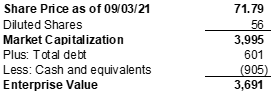
We continue to believe fair value for AMERCO shares to be higher than $200.  Below are current capitalization and valuation metrics for UHAL.

U-Haul capitalization chart 6/3/2013

We compare AMERCO to a selected number of publicly traded companies that operate a similar rental model, or benefit from “network effects” where incremental hubs / customers benefit the market leader.

AMERCO Comparable Companies

Compared to these comparable companies, AMERCO is significantly undervalued when considering that it generates a higher EBIT margin than most of these companies, is arguably in a more dominant competitive position, and has a large real estate business.  As it pertains to U-Haul, we think Waste Management (WM), Republic Services (RSG) and Sysco (SYY) are valuable comparisons in that they are high fixed-cost businesses that operate in commoditized industries, operate across the US, and are expected to grow roughly in line with inflation.  These businesses reasonably trade at ~8x EBITDA, 12x-14x EBIT and 17x-19x EPS.

In our opinion, AMERCO’s U-Haul business line has far superior economics to publicly traded car rental businesses such as Hertz Global (HTZ) and Avis Budget Group. The car rental industry is relatively competitive whereas in its market niche, U-Haul is the clear market leader and has an expanding competitive advantage.

Furthermore, unlike its car rental peers, AMERCO generates 30% of its cash flow from its valuable self-storage real estate portfolio. We believe that investors in self-storage REITs such as Public Storage (PSA), Extra Space Storage (EXR), CubeSmart (CUBE) and Sovran Self Storage (SSS) can achieve far superior risk-adjusted returns by purchasing shares in AMERCO relative to their REIT investments.

AMERCO REIT comparables

For a self-storage REIT investor, buying shares in AMERCO is akin to acquiring the third largest self-storage real estate portfolio in the US, while getting the nation’s dominant truck rental business at a large discount. If a REIT investor were to value AMERCO’s real estate at only 22x EBIT (a significant discount despite AMERCO’s taxes), this would value U-Haul’s truck rental operations at less than 2x EBIT.

It should be noted that although AMERCO does not pay a regular dividend yet, it does pay special dividends. Last year, its special dividend was $5.00 per share, nearly a 5% yield on the stock’s 2012 average trading price of $102.  We think that management’s track record of shareholder-friendly capital allocation policies will result in cash either being returned to investors or intelligently reinvested in AMERCO’s promising business lines.

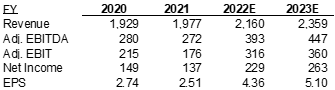
At current valuations, AMERCO shares trade at only 14x analysts’ estimate of 2013 EPS. AMERCO will be releasing its year-end results this week, and we expect the company will announce yet another record year for earnings. Furthermore, AMERCO could announce additional special dividends in 2013 given that the business continues to generate substantial free cash flow.


Click here  to log in to read the full post and/or comment. To read our full investment ideas or to post a comment, we ask that our users register here.


5.2.13
Posted by admin at 9:05 am
Disclosure:
We are short shares of NOW. Please click here to read full disclosures.

Yesterday, ServiceNow’s (NOW) largest shareholder, Sequoia, filed a Form 4 disclosing its first major divestiture of NOW shares.  The May 1st filing discloses a 6m share distribution that Sequoia quietly made to its limited partners on Monday (April 29th). This reduced Sequoia’s stake to 18.3m shares and transferred ownership of the 6m shares to an assortment of pension funds, endowments, and fund-of-funds that make up Sequoia’s limited partner base. While a direct share distribution partially absolves Sequoia from market timing decisions, it can place heavy selling pressure on a stock. This is because limited partners are typically not equipped to analyze individual public securities, preferring to instead sell shares immediately upon receipt. Since Monday’s 6m share distribution, NOW’s share prices has fallen by 7.8% on an average of daily volume of 2.4m. It can then be argued that this abnormal volume and price activity is the direct result of Sequoia’s distribution. As Monday’s distribution only represented 25% of Sequoia’s total ownership stake, additional forced selling may lie ahead.

Sequoia, along with JMI Equity and Greylock, was one of ServiceNow’s original venture capital investors. Sequoia first built its stake in November 2009, investing $51.6m for a 23.9m share stake. This equates to a cost base of just $2.15/share relative to NOW’s current price of $38.80. But as Fortune recently put it, “for many VC firms, getting into a hot company is easier than getting out.” Following NOW’s June 2012 IPO, Sequoia had their shares locked-up until the beginning of February. Rather than immediately distributing their shares after the lock-up expiration, Sequoia chose the hold shares through NOW’s April 25th Q1 2013 earnings release. They were rewarded as NOW shares traded to an all-time high of $43.39. While Q1 Billings were above consensus and revenue slightly beat estimates, forward-looking comments from management suggest that NOW’s growth may have topped out. On the Q1 earnings call, CFO Michael Scarpelli commented, “We’re still expecting a strong quarter in Q2. But we kind of expect going forward…Q2 to Q3 are pretty much going to be flat quarters from a bookings perspective.” The sell-side overlooked this comment, as well the weak Q3 and Q4 revenue numbers implied by full-year guidance, and issued their typical round of congratulatory research notes. Sequoia, on the other hand, decided it wanted to partly cash out.

After Wednesday’s Form 4 filing, Sequoia continues to hold 18.3m shares. As Sequoia’s limited partners are sitting on roughly 2000% paper gains, they will be eager to crystalize these profits. If a 6m distribution causes a two-day 8% correction, then further distributions may result in a similar outcome. And once the makeup of NOW’s shareholder registry completes its rotation from locked-up VCs to momentum investors and retail traders, future growth stumbles are less likely to be tolerated. This week’s Sequoia distribution, combined with the foreboding statements on the quarterly call, may finally induce a correction of NOW’s dotcom-era 16x 2013E Revenue multiple. We’ll be following the Form 4 filings closely.


Click here  to log in to read the full post and/or comment. To read our full investment ideas or to post a comment, we ask that our users register here.


3.25.13
Posted by admin at 9:03 am

Disclosure: We are short shares of EZCH. Please click here to read full disclosures.

Over the past few weeks, we’ve shared our EZCH investment opinion in a pair of articles, outlining our belief that EZCH’s $717m market capitalization, 8.0x 2013E revenue multiple, and 32.7x 2013E GAAP P/E (adjusted to include $0.39/share of stock-based compensation) are wholly unjustified. The Bull case depends on EZCH growing well in excess of the overall router market thorough 2016, a challenge we believe is unrealistic given an avalanche of near- and long-term business risks. Customer concentration is dangerously high, newly introduced competition from Broadcom could pressure design wins, Huawei’s recent order delay proves that in-house design risk is ever present, and weak end-market demand will pressure EZCH’s self-imposed 30% revenue growth hurdle (slide 8). To justify EZCH’s almost 2x valuation premium to the S&P 500, it must overcome this hurdle each and every year through 2016. Most EZCH investors discount these risks, instead trusting a management team that has over-promised and under-delivered for years, growing the revenue by just 11% annualized between 2009 and 2012. But since some took the time to reply to our article, we feel a response is due…


Click here  to log in to read the full post and/or comment. To read our full investment ideas or to post a comment, we ask that our users register here.


1.24.13
Posted by admin at 11:01 pm

Disclosure: We are short shares of MLNX. Please click here to read full disclosures.

Mellanox (MLNX), a stock that we’ve previously written up as a short recommendation, announced disappointing Q4 2012 results yesterday and gave catastrophic Q1 2013 revenue guidance. Though the stock initially dropped 22% after hours to $41, MLNX shares eventually rallied to $51 signifying a mere 1.4% decline for the day. Given three quarters of massive revenue declines ($157m in Q3 2012, $122m in Q4 2012, and ~$80m for Q1 2013) this is a stock that should be trading at a much lower level. With analysts having issued downgrades en masse and no longer supporting the stock with blind optimism, MLNX should reverse its intraday gains and fall to the $30s…


Click here  to log in to read the full post and/or comment. To read our full investment ideas or to post a comment, we ask that our users register here.


10.18.12
Posted by KerrisdaleCap at 1:10 pm

Disclosure: We are short shares of MLNX. Please click here to read full disclosures.

Mellanox’s third quarter earnings report, released yesterday after the market close, has given us an opportunity to provide an update on the situation. While the Company’s third quarter top-line results were slightly above analyst estimates, beating revenue guidance by 3.5% ($156.5m actual vs. $153m consensus), the Company’s fourth quarter guidance severely underwhelmed expectations. Towards the end of the prepared remarks, Mellanox’s outgoing CFO gave Q4 revenue guidance of $145m – $150m, indicating a sequential fall in revenue from Q3. As a company that traded at 8x forward revenue just before the earnings call, the anticipated slowdown in Mellanox’s revenue is catastrophic. This is particularly true because MLNX is undoubtedly a fast-money growth stock. Even worse, Mellanox expects a Q4 increase in non-GAAP operating expense of 6% – 8%, indicating that earnings per share will be hit by a double-whammy of lower revenues and rising costs…


Click here  to log in to read the full post and/or comment. To read our full investment ideas or to post a comment, we ask that our users register here.